
.svg)


What is design thinking?
Design thinking helps organizations create products, services, and strategies by balancing human needs, technical feasibility, and economic viability.
Desirability
Viability
Feasibility
Thinking like a designer can transform the way organizations develop products, services, processes, and strategy. This approach, which is known as design thinking, brings together three essential perspectives:
Desirability — Are we solving a problem that matters to people?
Viability — Can the solution succeed and endure within real-world constraints?
Feasibility — Can we build it with today’s technology and capabilities?
Together, these lenses describe the fundamentals of what makes a design successful in the world. But design is also shaped by the values we choose to bring to it. We place different weight on these three forces, depending on what we believe matters most.
At IDEO, we apply a human-centered value system to this balance, asking not only what can we create, but what should we create.
Holding these perspectives together helps teams move beyond invention toward outcomes that are meaningful, sustainable, and grounded in real human needs.
Desirability — Are we solving a problem that matters to people?
Viability — Can the solution succeed and endure within real-world constraints?
Feasibility — Can we build it with today’s technology and capabilities?
Together, these lenses describe the fundamentals of what makes a design successful in the world. But design is also shaped by the values we choose to bring to it. We place different weight on these three forces, depending on what we believe matters most.
At IDEO, we apply a human-centered value system to this balance, asking not only what can we create, but what should we create.
Holding these perspectives together helps teams move beyond invention toward outcomes that are meaningful, sustainable, and grounded in real human needs.

The origins of design thinking
Design thinking has deep roots in the design practice. Over time, it has become a widely used approach for tackling challenges across industries, from products and services to systems and strategy.
IDEO has practiced human-centered design since its founding in 1978, focusing on what people truly need and want in order to create more meaningful solutions. In the 1990s, IDEO’s approach gained wider recognition and helped popularize design thinking as a way for organizations to bring design methods into business, innovation, and problem solving.
IDEO didn’t invent design thinking, but we’ve helped make it more accessible through our work, our teaching, and the tools we’ve shared with others.
Leaders at IDEO such as David Kelley, Tim Brown, and Jane Fulton Suri played key roles in sharing these methods more broadly, integrating ethnographic research, behavioral science, and multidisciplinary collaboration into the design process.
David Kelley also helped found the Hasso Plattner Institute of Design at Stanford, known as the d.school, with the goal of giving more people the tools and confidence to approach problems like designers.
IDEO has practiced human-centered design since its founding in 1978, focusing on what people truly need and want in order to create more meaningful solutions. In the 1990s, IDEO’s approach gained wider recognition and helped popularize design thinking as a way for organizations to bring design methods into business, innovation, and problem solving.
IDEO didn’t invent design thinking, but we’ve helped make it more accessible through our work, our teaching, and the tools we’ve shared with others.
Leaders at IDEO such as David Kelley, Tim Brown, and Jane Fulton Suri played key roles in sharing these methods more broadly, integrating ethnographic research, behavioral science, and multidisciplinary collaboration into the design process.
David Kelley also helped found the Hasso Plattner Institute of Design at Stanford, known as the d.school, with the goal of giving more people the tools and confidence to approach problems like designers.
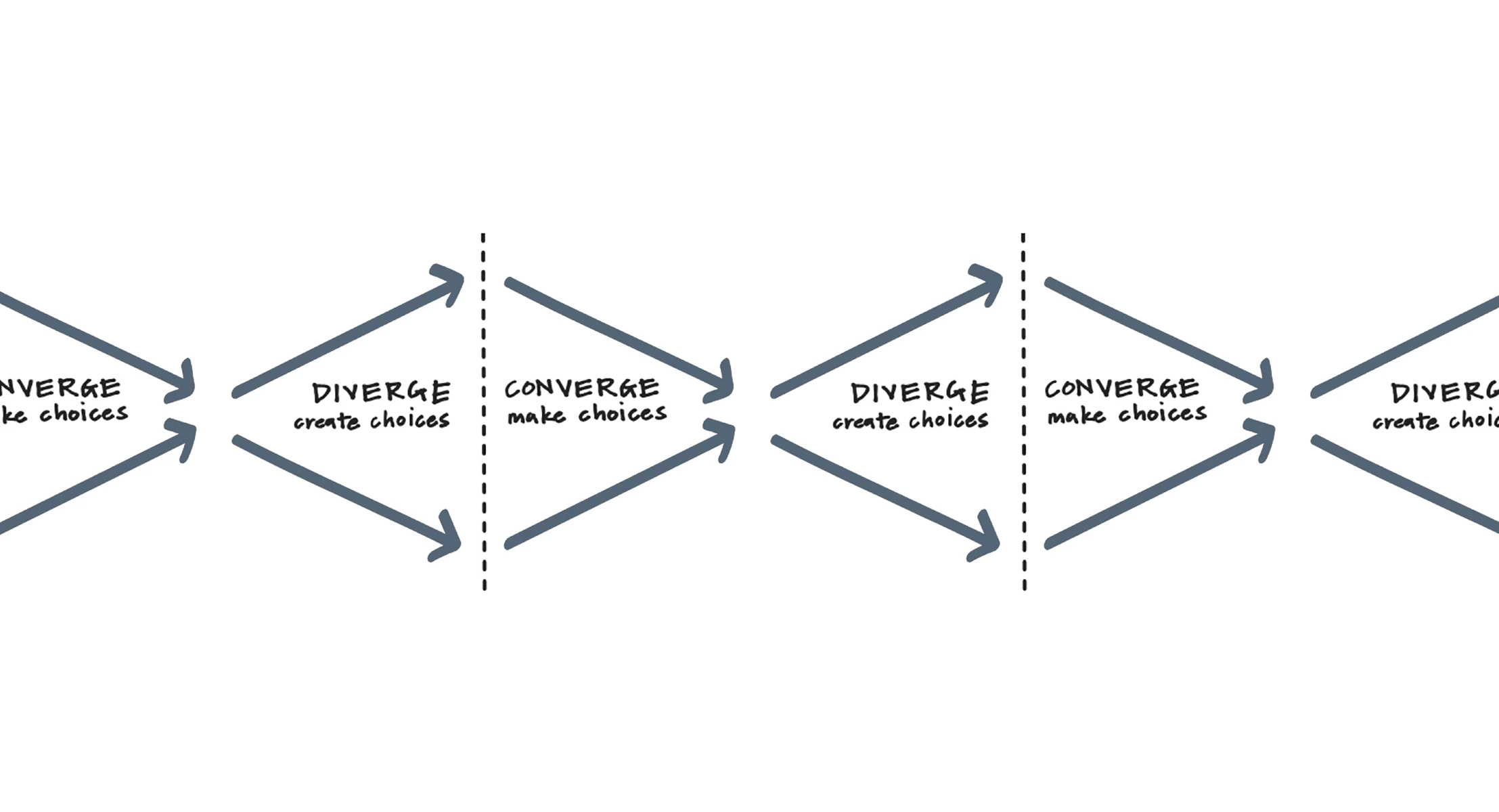
Design thinking & human-centered design
Design thinking is often used interchangeably with another design practice: human-centered design. But they're not quite the same.
Human-centered design reflects a core belief: that design should start with people—their needs, experiences, and contexts.
Design thinking describes how that belief is put into action. It’s a set of mindsets and methods for exploring challenges, generating ideas, prototyping, and learning through iteration.
You can think of human-centered design as the value orientation, and design thinking as a way of expressing and applying that orientation in real work.
Human-centered design reflects a core belief: that design should start with people—their needs, experiences, and contexts.
Design thinking describes how that belief is put into action. It’s a set of mindsets and methods for exploring challenges, generating ideas, prototyping, and learning through iteration.
You can think of human-centered design as the value orientation, and design thinking as a way of expressing and applying that orientation in real work.
Design thinking today
Design thinking continues to evolve as a widely practiced way of working in a world that demands more inclusive, responsible, and people-first approaches to complexity.
In many fields today, people may not even call it “design thinking.” They may simply call it good design.
What’s changed is the scale and complexity of the challenges we face.
Design thinking is especially valuable when working in conditions of:
- uncertainty
- complex systems
- rapid technological change
- new possibilities and risks introduced by AI
- problems that involve many stakeholders
In many fields today, people may not even call it “design thinking.” They may simply call it good design.
What’s changed is the scale and complexity of the challenges we face.
Design thinking is especially valuable when working in conditions of:
- uncertainty
- complex systems
- rapid technological change
- new possibilities and risks introduced by AI
- problems that involve many stakeholders

Learn the design thinking process
Explore the phases of the design thinking process and how to move between them to learn, iterate, and bring ideas to life.
Design thinking resources
Discover curated books, tools, articles, and videos to help you deepen your understanding and practice of design thinking.

FAQs
See answers to common questions about how design thinking works, how teams use it day to day, and why it helps organizations move from ambiguity to clarity.
Want more IDEO in your life?
For updates on our work at IDEO and to stay inspired with our thought leadership content, sign up to our newsletter.
If you want to keep learning and are looking for ways to continue evolving your creative talent, sign up for our IDEO U newsletter, too.