Archives For experience design

linkedin space 3 580px

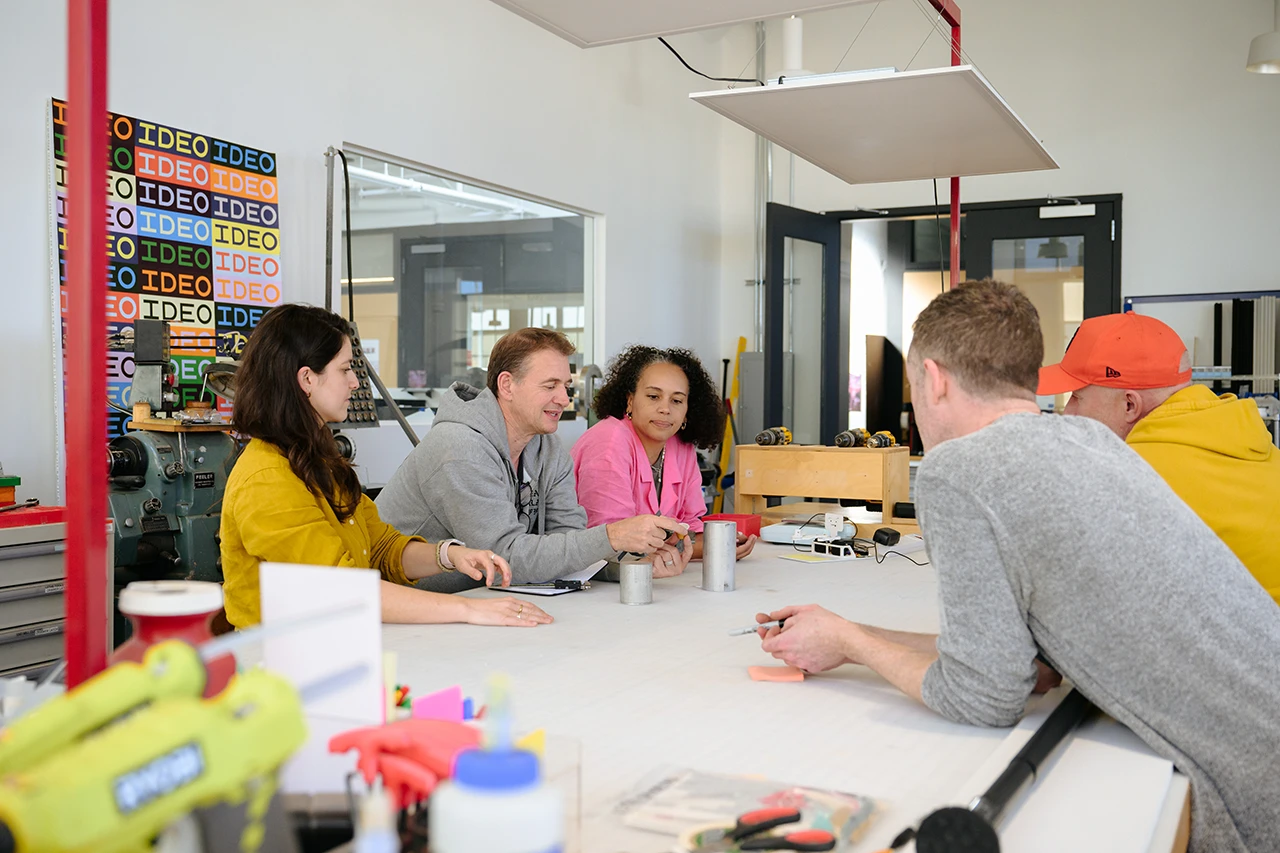
Project teams and small groups need to easily congregate—and then just as easily wander into private spaces for design iterations, coding sessions, etc. The mix of project rooms, smaller conversational nooks, and individual phone booths makes this possible. Our studio also allows for the high percentage of casual transient spaces needed to let folks easily collaborate.

This is a photo (above) of a corner of our San Francisco studio. The space is meant to enable the fluid nature of creative work at IDEO.

Individual IDEO-ers reserve a new desk space every week—meaning you never know who you’ll be sitting next to. This constant flux makes it easier to get inspired by colleagues in other disciplines. You never know when you’ll be sitting next to me!

At IDEO, we continue to create new spaces and work arrangements that invite inspiration, collaboration, and serendipity. Our spaces are ever-evolving prototypes.

(Posted also on my LinkedIn Thought Leader blog)

The future of the book

September 21, 2010 — 6 Comments

The Future of the Book. from IDEO on Vimeo.

Some folks in the New York office of IDEO have been thinking about the future of the book and how it shows up as an experience on tablets. They would love to get your reactions to the ideas.

It is interesting to think how a media morphs as it transitions to a new technology platform. In this case is this really about the ‘book’ or is it something entirely new? There is a conversation going on over at IDEO’s Facebook page.

Local Design

July 31, 2010 — 2 Comments

Giffords

I don’t generally travel to rural Oxfordshire, the place in England where I grew up, for design inspiration. History, beauty, friends and family – yes, but design – no. That is at least until I discovered Giffords Circus on my trip this summer. Giffords is a family circus that spends the summer months traveling around Oxfordsire, Gloucestershire and Wiltshire performing to small crowds in fields behind pubs and other such local landmarks. This is a tradition that has gone on in England for a century or more and to be honest most of these circuses are tired and a little sleazy – not so this one. From the beautiful and vibrant graphics of the program and map that shows the locations of performances; to the rigorous application of the ‘corporate identity’ on every vehicle the visual design of the circus is stunning. Beyond this the performance is delightful; a cross between Cirque de Soleil and vaudeville with inspirational music, amusing plot and loads of humor. The final touches include homemade cakes and drinks at the interval and even the option of a three course meal made from the best local ingredients with the performers at the end of the evening. A UK food magazine describes it as “one of the most enjoyable and memorable restaurants imaginable”.

This delightful experience is owned and delivered by Nell Gifford and her husband Toti (a landscape designer). It shows what can be achieved with the combination of imaginative design, enthusiastic entrepreneurship and talent.What would happen if our local school districts, city councils and health authorities exhibited the same imagination?

DLD

January 25, 2010 — 1 Comment

logo

I am spending the next day and a half in Munich before heading up to Davos for the annual WEF annual meeting. There is a great event that happens here every year called DLD (Digital Life Day) put on by Burda Media. You can think of it as a mini TED but with many more Europeans. The content is eclectic but I came away with a couple of interesting insights from today’s sessions.

John Nesbitt, author of the iconic Megatrends in the 1980′s, is just publishing his new book China’s Megatrends . He, along with his wife and venture capitalist Joe Schoendorf, were talking about what is really going on in China. One interesting comment from Nesbitt was “China is a country with no ideology”. Given the way China is represented in the western press this comes across as pretty radical but the point he makes is that China today is about the under 25′s and they are only interested in creating better lives and not in whether communism or capitalism are the right ways to do it. For those thinking about innovation in China the point is that our assumptions are not necessarily accurate.

In another session on health, moderated by Esther Dyson, we heard how health will be driven by user generated content and consumer applications. Products in the future will be a collection of therapies, monitoring, applications, communities and incentives. In other words they will be experience systems.

Finally, the CEO of Deutsche Post, the world’s largest logistics company as well as the German post office, talked about innovation in his industry. One thing that is interesting is that Deutsche Post is quite profitable unlike its counterparts in the US and UK. He was quite critical of the banking industry because he believes that business has to be based on meeting the needs of customers and taking responsibility for employees. He believes that much of the banking world has lost touch with both of these ideas and in many cases no longer serves customers with its activities. I agree with the essential nature of meeting needs but I might expand the idea of taking responsibility beyond employees to include the community in which business is practiced which for the largest companies includes much of the planet.

Simple or minimal?

October 26, 2009 — 39 Comments

There is a discussion going on amongst some of my colleagues about the merits of minimalism versus simplicity.

My own view is that minimalism has come to represent a style and as such is limited in its usefulness. It represents a reaction to complexity whereas simplicity relies on an understanding of the complex. This is an important difference. One is about the surface, about the stuff. The other is about our experience and requires a deep appreciation of how things work so as to make them just simple enough.

Minimalism is often all too obvious while great simplicity can be practically invisible. John Maeda of course talks far more eloquently than I about simplicity in his book of the same name.

I often look back to design history to find the best examples of simplicity. Sometimes it is the result of great restraint on the part of designers but sometimes it is a result of the limitations of technology. One example of just such an historical example is one that I personally experience every time I drive my nearly fifty year old Porsche 356 in the dark. With any modern car I find night time driving a disembodied experience with a Times Square like display of instrument lighting acting as a barrier between me and the world through which I am driving. My ancient old Porsche has no such isolating display. Instead I can see two crescent shaped slivers of light emanating from the headlights on the front edges of the hood. These perfectly designed beacons help connect me to the world outside in an elegant and efficient way, as well as helping reassure me that both lights are functioning properly, and are a result of the careful positioning of the edge of the headlights. Simplicity at its best.