Archives For design culture

linkedin space 3 580px

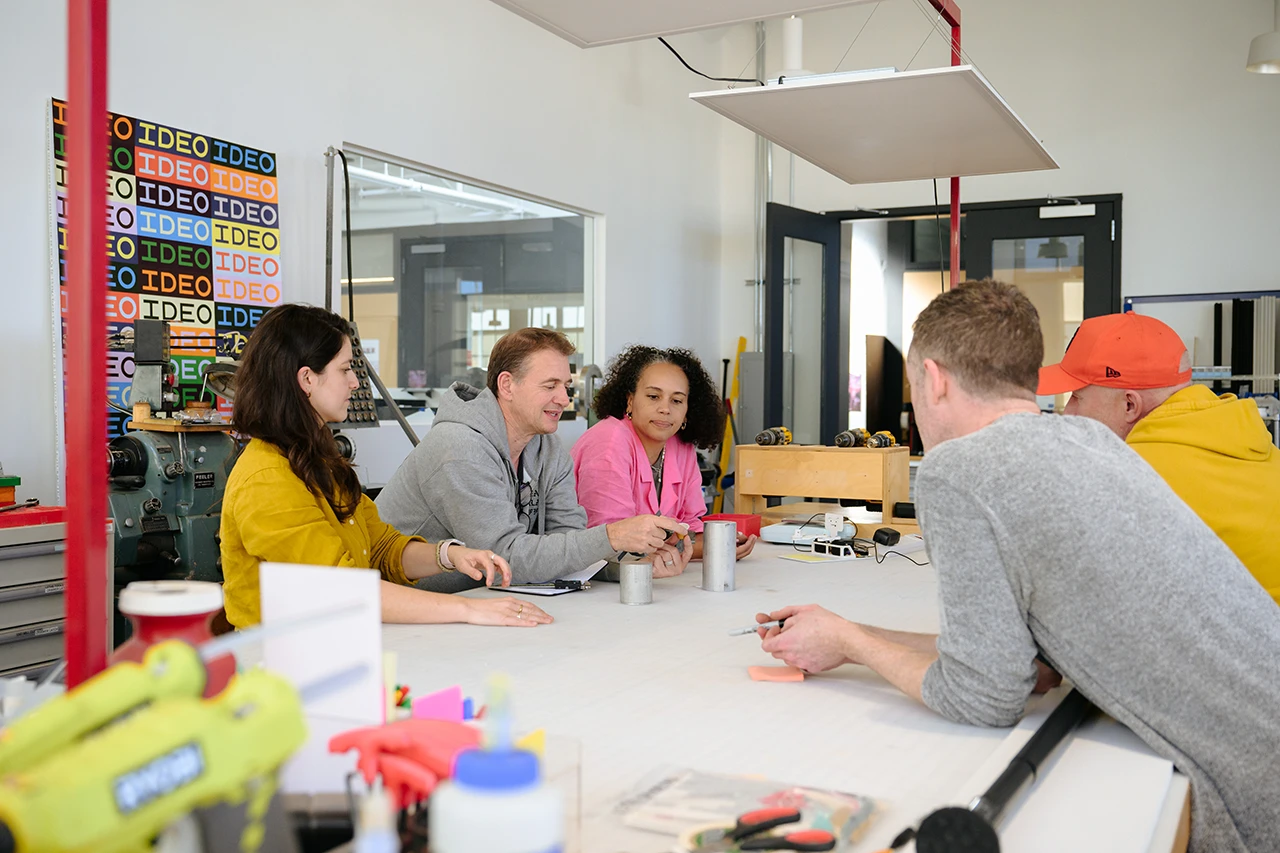
Project teams and small groups need to easily congregate—and then just as easily wander into private spaces for design iterations, coding sessions, etc. The mix of project rooms, smaller conversational nooks, and individual phone booths makes this possible. Our studio also allows for the high percentage of casual transient spaces needed to let folks easily collaborate.

This is a photo (above) of a corner of our San Francisco studio. The space is meant to enable the fluid nature of creative work at IDEO.

Individual IDEO-ers reserve a new desk space every week—meaning you never know who you’ll be sitting next to. This constant flux makes it easier to get inspired by colleagues in other disciplines. You never know when you’ll be sitting next to me!

At IDEO, we continue to create new spaces and work arrangements that invite inspiration, collaboration, and serendipity. Our spaces are ever-evolving prototypes.

(Posted also on my LinkedIn Thought Leader blog)


curtain chef 580px

I am fascinated by how things are made. For me, having a sense of where something comes from gives me a much deeper connection to a product. That is why I love the segment in Gary Hustwit’s movie Objectified that shows Jasper Morrison’s Air Chairon the production line, and the interview with Apple Design Head Jony Ive where he talks about designing the fixtures to make Apple laptops. The more I know about how a product gets into my hands, the more I value it.

I think the same is true of services. I was reminded of that the other evening at, of all things, a performance of Shakespeare’s Twelfth Night. Ordinarily when attending a theatrical performance we enter the theater and sit patiently in front of a closed curtain while the actors and production staff are busy getting ready. The convention is that we should be separated from the preparations so as to maintain the suspension of disbelief.

For this performance at London’s Apollo Theater however, the preparations became part of the performance. On entering the auditorium we were faced with a stage full of benches and tables with actors coming and going. They were putting on costumes, applying makeup, and chatting with each other just as you would imagine happens in the backstage dressing rooms. As favorite actors came and went we felt drawn into the company and part of the process. The quality of the performance was superb, but that small glimpse behind the curtain certainly enhanced the experience for me.

I feel the same way about restaurants, where I love sitting so that I can see into the kitchen and watch the chefs at work. Again, the food seems that extra bit more interesting when I can see how it is prepared.

I would suggest that any product or service experience can be enhanced by letting the customer see behind the scenes. Of course, to do so we must be as proud of what happens ‘offstage’ as we are of what happens ‘onstage.’ This requires careful design, but in markets where the alternative is commoditization, anything that creates a deeper connection to the customer is an advantage.

Where might you create a glimpse behind the curtain for the customers of your product or service?

(Posted also on my LinkedIn Thought Leader blog)

photo Jeffery Cross Heath 580px

“When I walked into Heath it sounded so different from my office.”

It was this visceral difference between the sounds of a small ceramics manufacturer and those of a consulting design studio that got Cathy Bailey started on the path to co-leading Heath Ceramics. In partnership with her husband Robin Petravic, Cathy has shaped Heath into an icon of the San Francisco manufacturing revival. I got the chance to sit down with her after a recent IDEO Design Evenings event to chat about the challenges and rewards of designing a business. Some highlights from our conversation:

Ten years ago Cathy Bailey was tiring of design consulting. While out looking for ideas that might be the genesis of a startup, she came across Heath, a Sausalito-based ceramics manufacturer founded in 1947 by Edith Heath. While not a startup, Cathy realized that Heath was a business with “good bones”—and that the 50+ year-old company was a place where “people really cared about what they were making.”

What followed was a process of editing, rebuilding, and redesigning much more than the Heath product line. Cathy and Robin’s challenge was to redesign the business itself and create a company where “design is the whole thing”—the business model, the culture, and the story.

Many small manufacturers of craft-based products have disappeared, because the traditional business model of creating relatively high cost products distributed through wholesale channels results in prices that the market cannot support. Heath Ceramics has shifted to direct-to-consumer for the vast majority of its sales. This means that as a manufacturer, Heath must now go beyond the products and take responsibility for designing a great consumer experience both digitally and at its retail outlets. The reward for this broader investment in design is the capture of more profit margin. This is a lesson learned by the likes of Apple, as well as Heath—and one that could be a applied by many more high quality, low volume manufacturers.

“The culture had good bones but it was nostalgic.”

How do you go about evolving a culture that is more focused on the past than the future? One of the unexpected challenges, and one of the reasons it took a while, was the time needed to connect to and understand a group of people who were totally different in their backgrounds and experience. As designers, Cathy and Robin had been used to spending most of their time with people who were essentially similar to themselves. Now they were working with craftspeople who could offer considerable perspective when it came to the products and the craft but had never been asked to engage with the broader design of the business. The first step was to open the books to employees so that they had the opportunity to understand what design trade-offs might be necessary. This first step “changed the dynamic” of the culture.

Heath Ceramics is as much a story as it is a selection of products. It has a rich set of narratives ranging from its founding by Edith Heath in 1947 to its deep expertise in glaze. Celebrated restaurants such as Chez Panisse and The Slanted Door use Heath ceramics, making it a part of the San Francisco food movement as well as the manufacturing and craft revival.

Despite the challenges and risks of reinventing a small craft-based manufacturing business in the USA, Cathy tells me, “it’s not such a risk if we can tell the story.”

Might this idea of designing the whole business be the basis for a resurgence of craft and manufacturing elsewhere in America?

Photo by Jeffery Cross / Courtesy of Heath Ceramics

(posted also on my LinkedIn Thought Leader blog)

DLD

January 25, 2010 — 1 Comment

logo

I am spending the next day and a half in Munich before heading up to Davos for the annual WEF annual meeting. There is a great event that happens here every year called DLD (Digital Life Day) put on by Burda Media. You can think of it as a mini TED but with many more Europeans. The content is eclectic but I came away with a couple of interesting insights from today’s sessions.

John Nesbitt, author of the iconic Megatrends in the 1980′s, is just publishing his new book China’s Megatrends . He, along with his wife and venture capitalist Joe Schoendorf, were talking about what is really going on in China. One interesting comment from Nesbitt was “China is a country with no ideology”. Given the way China is represented in the western press this comes across as pretty radical but the point he makes is that China today is about the under 25′s and they are only interested in creating better lives and not in whether communism or capitalism are the right ways to do it. For those thinking about innovation in China the point is that our assumptions are not necessarily accurate.

In another session on health, moderated by Esther Dyson, we heard how health will be driven by user generated content and consumer applications. Products in the future will be a collection of therapies, monitoring, applications, communities and incentives. In other words they will be experience systems.

Finally, the CEO of Deutsche Post, the world’s largest logistics company as well as the German post office, talked about innovation in his industry. One thing that is interesting is that Deutsche Post is quite profitable unlike its counterparts in the US and UK. He was quite critical of the banking industry because he believes that business has to be based on meeting the needs of customers and taking responsibility for employees. He believes that much of the banking world has lost touch with both of these ideas and in many cases no longer serves customers with its activities. I agree with the essential nature of meeting needs but I might expand the idea of taking responsibility beyond employees to include the community in which business is practiced which for the largest companies includes much of the planet.